Tuesday, February 23, 2010

Inside Out

Back in December we started to put more of our effort into getting the "business" side of Whizbang into place. We began to capture the costs involved in getting the first game completed and started estimating our overall time spent on each step of the process of getting a custom pinball machine not only finished, but marketed and hopefully sold to a happy customer. And then more happy customers, and so on, and so on. Of course, it's now February and we're still capturing data but we now have a better idea of what it's going to take to get Whoa Nellie Big Juicy Melons grown, ripened, hand-picked, marketed, packed, and shipped. But let's get back to the fun stuff!

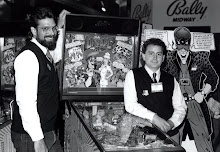
Near the end of December we invited Mark Weyna out to take a look at the project and see if he could lend assistance by removing the main "bottom" board (the Brains of the game) inside the cabinet and work on getting it cleaned up and "shopped" so it would be clean and working once we put it back in the game. Mark worked with us at Williams and Midway in the late '90's in the role of assistant designer, and later Game Designer, on games like Scared Stiff, Indy 500, and others. Mark was instrumental in a small but important mechanical detail on Scared Stiff - the small flap on the ramp that accepts the ball (like butter) from the Spider Hole "up-kicker" under the playfield. He also convinced us that reprising the "Dude-O-Meter" from Dr. Dude and renaming and repurposing it to the "Stiff-O-Meter" was a good thing for the game. From L to R: Greg, Mark, Dennis, unidentified woman, Mike Boon

Mark also has a great collection of EM pinball games from the '50's and '60's and collects some really great antique coin-operated equipment like music boxes, slot machines, nickelodeons, and other unique novelty games. With all this electro-mechanical equipment in his possession he's a great resource for EM restoration and repair. He's also a motorsport enthusiast and likes to drive antique sports cars so he knows quite a bit about how to keep things running...or get them started. Mark took a look at the main board in Dennis' shop and did a quick evaluation of what it might need. He then took it back to his shop to give it the TLC that it needed. He checked for loose wire connections and bad or cold solder joints. He cleaned each part and made adjustments to leaf switches. He found the more he cleaned or moved stuff around the more he had to repair. It's been 53 years since this game first rolled off the assembly line so, just like us, things start to dry up, decay, or get a bit frazzled over a lifetime of use and abuse. The focus of a surgeon. Mark also stripped off all of the components from the board and even took the time to not only clean the original plywood panel as much as possible, without removing the original ink-stamped markings for the fuse values, but also clear coated it to add that extra bit of lustre. "I was taking a more 'conservation' approach, but now that I see it sitting in the cabinet, I may want to take it apart again and just sand the wood clean and re-coat to better match the over the top polishing Dennis has done on the rest of the interior cabinet parts." Mark also added a new line cord to bring it into this century. During that same week, Ken Walker had mentioned to us that a group of pinball enthusiasts from the Chicago area were going to meet for an end-of-year get-together at a place called Brixie's in Brookfield, Illinois. (An aside for Beer lovers: this is a great place with a huge variety of microbrews on tap.) We thought it would be a good opportunity for Mark and Ken to meet each other, since both would be working on the guts of Whoa Nellie, so we all met up and had a great time meeting new people and talking pinball. (I also played one game of CSI that was set up for Tournament Only with shorty flippers for a buck a play - rediculous!) We also set up a follow-up meeting back at the studio in mid-January to hopefully get the other two Continental Cafe games up and running.

On January 16th Mark brought the finished board back to the studio. Before this, Dennis had thought about painting the inside of the cabinet to give it that extra Whizbang quality. He asked me to find a suitable "melon" color at the Home Depot paint department since I'm the "artist". I walked into HD and in less than 30 seconds found a swatch that seemed appropriate...aptly named "Cantaloupe"...that was easy! So by the time we got together on the 16th, we had a juicy cantaloupe color painted inside the main cabinet and backbox. Of course we thought about 7 more cool things we could do with the inside of the cabinet but we thought it better to put our combined energies where most people would see it. And Mark's "shopped" bottom board looks very nice inside the painted cantaloupe cabinet. Ken asked if it would be ok to bring a friend to the studio, another pinball enthusiast, Chris Edler from the St. Louis area, who was in town for a monthly pinball players gathering in the suburbs of Chicago. Both Ken and Chris have worked as airplane mechanics so to have two skilled mechanics in one room, along with both Ken and Mark's expertise in the mechanical coin-op world, we felt that these aging Continental Cafe's were in good hands. And perhaps by the end of the day the games would not only be running, but flying as well. Mark and Ken plugged in the two CC games and started troubleshooting to find out any and all problems that might have plagued the games during the later years of operation. "When Ken and I dug into the other games it was very much the normal stuff to fix on games that have been sitting for a long time...freeing slow or stuck wiper assemblies so the games would try and reset, then look for stuck/bent switches to stop the 'coil-cooking lockup'. Once things are pretty much working it's time to look for the ONE thing that was broken/cooked, or out of adjustment that caused the operator the retire the game waaaaaay back then. Sometimes that can be quite the treasure hunt." "Usually after a little cleaning, lube, a few electrical shocks and some swearing the old EM's spring back to life pretty well." Both Mark and Ken (and anyone that collects EM games) agree that the worst thing for EM games is to sit for long periods of time without use. Once these games are playing again, they can keep going for a long time.

One of the most integral mechanical pieces on the main bottom board is the "Score Motor". Ken explained that it basically scores things in multiples of 5's or 3's and is also used in the reset process, whether for drop targets, new game or bonus count downs.
Here's a crappy low-res video just for some blog variety to show the mech in motion.

Mark and Ken got both games running in less than an hour and then we spent some time brainstorming some ideas for the playfield and the possibilities of what may or may not be possible by adding a feature to the game.
This is proving to be a more complicated process than anticipated and we are still in the process of getting a better understanding of what could work for the game and help push the former CC design into a different layout with a similar rule set or scoring configuration. We want to be able to provide a more unique game play experience from the original Continental Cafe layout, but we also want to finish this project, as promised, in 2010.

All in all it was a great day...we got a lot accomplished (we being Mark and Ken), Chris learned a bit more about EM games, Dennis stood around in amazement, I took pictures, and Ken got to see some of the brainstorming techniques that Dennis, Mark, and I haven't done together since 1996. (Ken actually got to hear me speak in tounges when I disagreed with one of Dennis' suggestions - but Dennis is used to that.)
And one more crappy low-res video for your entertainment.


Next time we'll preview the wonderful world of color.
G&D

All art, sketches, or photos related directly to "Whizbang Pinball" or "Whoa Nellie (Brand) Big Juicy Melons" or "Whoa Nellie (Brand) Sweet Juicy Melons" are TM and Copyright 2009 WhizBang Pinball, Greg Freres, and Dennis Nordman.

Photos on this post provided by G.Freres, M. Weyna, and Nicholas Weyna

Saturday, February 6, 2010

Whoa Nellie - There's a Plane in the Pond!


So our anonymous commenter who I'll refer to as "Steve", for lack of a better pseudonym, nearly nailed the "What is it?" by at least somewhat connecting the part to a portion of an aircraft gone awry. If this had been an actual contest, "Steve" would have scored extra points for using the term "cowling". Instead, "Steve" wins the hand-painted pork chop, signed by Dennis and I. Maybe some of my hints helped lead the rest of you to this piece of WW2 hardware.

It's the front, right-side, engine cowling from a SBD Dauntless dive bomber. However, the picture below (public domain) is unfortunately of the left side.

Ok, now it's the right side.

So how'd this thing make it to Dennis' studio?

Dennis explains:
"In the early 1940's the SBD Dauntless crashed in the lake behind my grandfather's orange grove during a practice drill shortly after take-off from the DeLand, Florida Naval Air Station, only about two miles away. Fortunately, the pilot bailed and survived. Periodically, the lake dries up and, years later when we'd visit my grandparents, we'd go exploring on the property and find smashed up pieces of aluminum in the mud. This is the only identifiable part we found. When I brought it home from Florida a few years ago, my wife looked in the truck and said, "What's that piece of sh*t?!" Women...they just don't understand!"

You'll probably be seeing more vintage aircraft references ahead because Dennis digs planes (even out of dried up ponds.) Below he proudly displays his "Contact" backglass that he dug out of his woodpile, near the "Super Rack"...a follow-up theme to "WNBJM"?


Next time we'll get back to the project and dig into the guts of Continental Cafe.

Until then, I just have one question...was the Dauntless really "Silent But Deadly"?

G&D...SBD

All art, sketches, or photos related directly to "Whizbang Pinball" or "Whoa Nellie (Brand) Big Juicy Melons" or "Whoa Nellie (Brand) Sweet Juicy Melons" are TM and Copyright 2009 WhizBang Pinball, Greg Freres, and Dennis Nordman.

SBD Dauntless photos courtesy of the National Museum of Naval Aviation

"Contact" and "EM Close-Up" photos by G. Freres

Sunday, January 31, 2010

10 "Followers" - A New Milestone!

Hootie-Hoo!
We now have 10 official WhizBang blog "followers"! So what if half of them are family members, we've hit a new milestone!

Thanks to everyone that's been following from the start, even if you haven't signed-up officially. It's been fun sharing our progress with eveyone in the Blog-O-Zone and we have plenty more where that came from, so stay tuned.

Now if we only had a Blog-O-Meter to count how many people are actually reading this thing. I keep telling Dennis there's at least 10 readers, and this post proves it!

More fun to come...we're gellin'!

G&D

Side-Effect Warning: For hard-core collectors,pinball enthusiasts,art critics, or supporters of all that is politically-correct in the world, reading this blog may cause consternation and lead to the formation of opinions. If opinions persist, please share them as comments to relieve the pressure. If you have an opinion that takes more than four hours to type, seek medical attention immediately, as this may be a sign of a more serious condition.

Thursday, January 28, 2010

Back to Backglass


Welcome back to the Whizbang design studio, or as Dennis calls it..."my shop." After spending more time in the "studio" (since I'll be talking more about art on this post than woodworking), I started to notice some interesting decor items just hangin'. Like this thing above the entry door...


I think it will be interesting to elicit some comments on this one, eh? So what is it? Go ahead...take a guess...and leave it in the comment section below. And be creative. There are several people that know exactly what it is, so please don't give it up. We'll reveal the answer in the next post.

We also thought it would be fun to put one of the latest acquisitions next to the semi-finished Whoa Nellie cabinet just to get a preview of the major before and after customizing. Dennis chose "Pinky Continental" to further illustrate the difference.


Progress! Every few weeks we get another jolt of it and it definitely motivates us to keep pushing on.

After reviewing some playfield layout revisions with Ken Walker and Steve Charland from Team EM, Dennis had some strong possibilities for what he wanted to try and decided that eliminating one "player" from the two-player configuration of Continental Cafe might allow for more potential tweaks in the scoring department. And since the Whoa Nellie version of the game would never be on location again as a coin-operated device, we felt that a change to a one-player game wouldn't be a bad thing, in fact, it would be great for the art on the backglass.

Here's a view of the original "insert panel" that I mentioned on the last post. Two sets of scoring reels for the two-player set up.

We were amazed at the lack of what's called "general illumination" on this backglass. Only several lights were dedicated to lighting the main portion of the art, and, only a small portion of the art was "open" on the opaque screen layer. Years later, at least twenty to thirty lights were allowed in the matrix to light the backglass.

For the "newbies to pinball" reading this blog, the lights surrounded by small wood frames, or what we called "egg crates", illuminate what's called "hidden copy" or words or numbers that light up only at certain times in the game. For an example, words like "Tilt" or "Game Over" only get lit up at certain points in the game. The "egg crate" allowed for the light to focus only on what the artist allowed for by use of an "opaque" layer printed on the back surface of the backglass.

So looking at the back of the CC backglass above, the numbers across the top on the upper left were printed only on the opaque screen, or should I say left open on the opaque screen, allowing the light to pass through the art layers only when it was lit up, otherwise it was hidden from view. The egg crates also prevented ambient light from lighting any of the hidden copy until it's specific light was lit. Apologies if my explanation is as clear as mud.

Also note that there is absolutely nothing printed (clear glass) where the numbers on the score reels will show through. As opposed to our vintage glass below that lost most of it's art throughout the years but may just come in handy now to help illustrate my seminar on Backglass Art 101.


Before getting to this stage, I had started the backglass layout as a two-player layout, just like the original CC. My first rough sketch from a few months ago allowed two roughed-in areas for the score reels.

I included areas for the "hidden copy" as well and worked to a drawing that Dennis made from copying the dimensions from the original layout. Dennis asked if I wanted to move things around a bit for better composition, I could give him a copy of my next iteration and see how much he could move items, like the scoring reels, the credit window, or perhaps some of the hidden copy.

So while I started to add ideas and elements to my design, I kept these kind of changes in mind and worked closely with Dennis over the phone to make sure I wasn't designing something that couldn't be supported by the new insert panel.

After thinking about what kind of Roy Parker-esque people I wanted to add as background elements, I also made the decision to turn our hero around,(who I'll now refer to as Melanie, or Melony, due to results from an ongoing straw poll that started at Pinball Expo), so that the guy in the truck would now be reacting to her melons rather than her backside (not that there's anything wrong with her backside...trust me...I'm an artist.) Once I roughed-in the other farm hands gawking at cantaloupes, I felt good about the decision to "turn her all about."

Which reminds me of a sign I saw last summer that I really need to get for my studio just to remind myself of the important things in life...the sign read...

"What if the Hokey Pokey IS what it's all about?"

Something to think about. I think about it often.

So on my next pass, Melony did an about-face,I added the farm hands, and got the all important horse and rider into the background, and appropriately, just below the title.

I worked with Dennis to move the scoring reels to the left to accomodate the layout and I started feeling pretty good about the general composition. This sketch was still before we made the switch from Sweet to Big.

A few weeks later Dennis suggested that we bring this layout to Pinball Expo to help support the direction of our project but I was reluctant to show such a preliminary sketch. There was a lack of detail and Melony's face was not anywhere near the quality that I wanted it to be. I was afraid people wouldn't see it as a sketch, that it didn't represent all that I could do as an artist. But, after talking me down off the roof, Dennis finally convinced me that having this sketch as part of our initial presentation was important in the big picture. I conditionally agreed. First, the sketch would be clearly marked as a "Work In Progress", and second, I would take some time and revise Melony's face just slightly to get her closer to how she could end up looking. Deal! And Dennis was right, the combination of the partially finished cabinet along with the rough sketch for the backglass seemed to help get our idea across to most of the audience. You can also see this in the latest Pingame Journal.


Jumping ahead a couple months, we made the decision to change the final game to a one-player game and I eventually returned to the backglass for more revisions. Dennis made some final adjustments to the insert panel drawing and built it to get it into the game. After getting this pass of the layout to best match his drawing it was time to get it printed at full size to see how well it matched the real insert layout.


Finally...BIG!


Happy Artiste!

Progress! It's what we eat for dinner!

One more time leap, if you can handle it, and now I updated the sketch one more time this month, yes, January 2010, and triple-checked the insert layout from Dennis with my full-size sketch and overlayed the two files together for one final check before lift-off.

I wanted to make sure we were good to go since my next step would be to start designing a color sketch. Our goal is to get backglasses printed first and offer them for sale as soon as we can. But we have plenty of business to get situated before that happens, so stay tuned for more details!

Next time we'll start digging into the nuts and bolts, switches and relays, and bring in our friendly experts to do it right. And a paint job for the ages.

Until then, don't forget to comment on..."What is it?" and try not to get hung-up on that Hokey Pokey thing...it's just a humorous sign...or is it?

G&D

All art, sketches, or photos related directly to "Whizbang Pinball" or "Whoa Nellie (Brand) Big Juicy Melons" or "Whoa Nellie (Brand) Sweet Juicy Melons" are TM and Copyright 2009 WhizBang Pinball, Greg Freres, and Dennis Nordman.


All photos on this post by G.Freres and D. Nordman

Monday, January 18, 2010

Taking the Plunge

The part of the cabinet redesign that was keeping Dennis up at night (writer embellishment) was the ball-serve mechanism and the related trough that had been originally factory-routed into the side of the cabinet. For those less familiar with earlier woodrail pinball games like Continental Cafe, once you sent your coin into the slot to play the game, you, the player, were responsible for getting the ball up to the plunger. Modern games take care of that for you by automatically feeding the ball via a push from a solenoid. But back in 1957, there was a small push-rod below the plunger that, when pushed forward, smoothly delivered the ball to its resting point in front of the plunger tip.


Once Dennis had made the decision to cut the main cabinet across the top to be parallel with the bottom (to look more like a real crate and not so much like a pinball cabinet), this created the need for an adjustment to the ball-serve routed trough and the placement of the related mechanical parts, because the original trough was truncated in the process of cutting off the top of the cabinet.


If you're still following this amazing non-truncated tale, the next step was to call Jimmy John's. After lunch, Dr. Dennis formulated a plan of action and started to rectify the situation. The first step in this surgical procedure was to painstakingly fill the original trough with a perfectly formed piece of wood, shaped somewhat like a banana...or a Kielbasa. (I can't wait to get back to talking about Melons).


Before creating the new groove, Dennis had to order a new bit for his plunge router. It set him back about $54 but there was no other way to get 'er done. The day arrived...and he took the plunge. As Dennis recounted the episode, he started with..."Everything was going really well, the new bit was doing exactly what it was designed to do."

Unfortunately, the depth adjustment wasn't locked on the router and...


...the bit changed the groove to a hole in a nanosecond. Doh!

Knowing Dennis, I'm sure he kept his cool and knew exactly what he would do next. Within a few minutes (writer's embellishment #2), Dennis had the hole plugged with wood, made sure the router depth was locked, and created the perfect finished trough.


Dennis double-checked the mechanism and the trough location and put all the parts back together to test the lift.


It all worked as planned and another angst-ridden phase of the project was completed. Dennis followed up with the Lock-down mechanism to make sure the new hand rail would seat properly.


The old metal parts were wire-brushed and clear coated to aesthetic perfection.


Somebody fetch my shades...


Did I mention the new hand-rail is made from maple and provides the needed comfort for the long hours of play this game will endure someday? (Writer embellishment #3 or just a stab at some positive PR.)

Dennis also spent some time on the front of the cabinet filling holes left by coin-mechs, coin returns, start buttons, etc. Since the game will never be used on location again, the coin mechs won't be needed. Eventually the recessed area of the front will get covered with a decal as well, including the old coin door. And also note the original serial number for the Continental Cafe game has been left intact in the center of the cabinet front...M50874CC. But soon to be known as WNBJM #1. Below is a quick study of the revised cabinet front compared to the original. (Note: The cabinet front used in this "before" picture is actually CC Game 2,thus the difference in serial numbers.)


Our next step was to spend some time thinking about the backglass layout as it relates to the backbox insert panel (the piece of wood that holds the scoring reels and all the lights to illuminate the backglass.) At this point we were thinking about changing the game to a one player game because of some playfield design changes Dennis wanted to try.

Until then, always remember...a banana shaped trough is never as easy as it looks.

G & D

All art, sketches, or photos related directly to "Whizbang Pinball" or "Whoa Nellie (Brand) Big Juicy Melons" or "Whoa Nellie (Brand) Sweet Juicy Melons" are TM and Copyright 2009 WhizBang Pinball, Greg Freres, and Dennis Nordman.


All photos on this post by G.Freres and D. Nordman